
In a bid to stem the spread of the contagion, the authorities in Beijing have conducted the nucleic acid test on 29,386 people who had visited the Xinfadi wholesale market since May 30, Gao Xiaojun, spokesman for the Beijing Health Commission, said on Monday. The market became a hotspot after it reported several new COVID-19 cases. Out of all the samples, 12,973 came negative and the rest are awaiting results, Gao told the media.
The Chinese capital reported 106 domestically transmitted COVID-19 cases since June 11 and a senior city official warned that the situation is "extremely severe" in Beijing where authorities have mounted massive containment measures including mass testing of about 90,000 people.

Here's this week of photos that prove we live in a mad world.

The talks took place in a beach resort in Benaulim on the sidelines of a meeting of the Council of Foreign Ministers of the Shanghai Cooperation Organisation.

Premier Li Keqiang on Tuesday paid tributes to the memory of a young Indian doctor who treated wounded and plague-stricken Chinese soldiers on battlefront during the Sino-Japanese war of the 1930s, becoming one of the most revered and enduring links between the two countries.

'Does it mean that we are witnessing the end of an era?' 'Probably not, but the post-Trump trade war has certainly brought a lot of instability in China,' notes Claude Arpi.

Traces of radiation from the ruptured Japanese nuclear power plant are being felt in several parts of China and low levels of radioactive iodine-131 were detected in the air in capital Beijing, Tianjin, Ningxia Hui, Shandong, Hebei, Henan and Shanxi provinces.

These images from across the globe tell that it is a crazy world out there!

The Chinese capital Beijing was shrouded in thick brown dust on Monday morning as a result of heavy winds blowing in from Inner Mongolia and other parts of northwestern China.

China's National Health Commission said on Wednesday that 93 locally transmitted COVID-19 cases and 16 new imported cases were reported on Tuesday, the highest in a single day in recent weeks.

China on Saturday issued a yellow alert for smog as the pollution choked most regions in the country's north with no signs of abating.
China has just 12 days of coal reserves left at most of its power stations, after the end of a cold and stormy winter. Some provinces, including Hebei, bordering Beijing, have less than a week's coal left. This is a record low, the state electricity regulatory commission revealed. Coal imports, which started last year, have also failed to meet the difference between supply and demand. This raises questions about how much longer China's breakneck industrialisation can continue
Monday also saw the new confirmed infections of COVID-19 outside Hubei reduced to a number lower than 100 for the first time, Mi told the media..
The total deaths from the more than two-month-old outbreak as reported on Thursday stood at 1,367, with the total number of confirmed cases mounting to 59,804, health officials were quoted as saying by the state-run Xinhua news agency.
Eighty-nine deaths were reported on Saturday -- the highest single-day death toll -- and there were 2,656 new confirmed cases of the deadly infection, China's National Health Commission said in its daily report on Sunday.
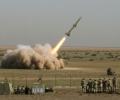
The People's Liberation Army Rocket (Missile) Force tested the new missile in the Bohai Sea.

Beijing's sky was gloomy and the ground largely deserted.

From captivating photos of Northern Lights, sparkling galaxies, the 'man on the moon' and more, photos taken by the winners of the Insight Astronomy Photographer of the Year 2016 competition are an absolute treat.

Air quality in the city of 16 million is usually bad in winter.

It is important to note that slowdown in activity is really confined to a selected few regions within China.
 © 2026 Rediff.com - Advertise with us - Disclaimer - Privacy Policy - Sitemap - Feedback - About us - Terms of use - Grievances